An axial angular contact ball bearing carries high thrust load at high running speed, using balls set at an angle against the raceway instead of straight across it. It is the standard choice for ball screw support and machine spindle ends where speed and precision both matter.
Grinding the contact angle correctly is what separates a good axial angular contact ball bearing from an average one, since even a small error changes how the load carries across the balls at speed. At Shree Balaji Export, our precision grinding line holds tight tolerance on contact angle, roundness, and surface finish, and every bearing is speed-tested before packing. We ship these high-speed thrust bearings to customers in Sri Lanka, South Africa, the UAE, Nigeria, Egypt, Indonesia, Thailand, and Kuwait, and our export desk prepares the paperwork needed for smooth customs clearance on arrival. Explore our full catalogue and request pricing at Shree Balaji Export.
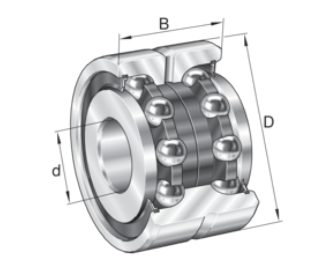
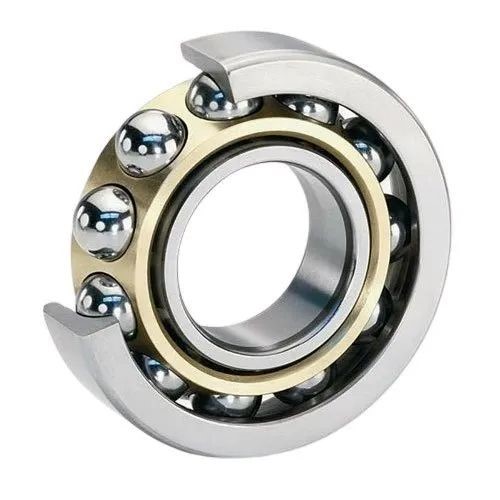
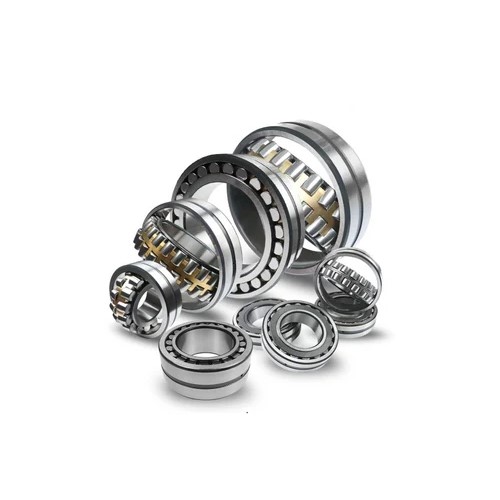
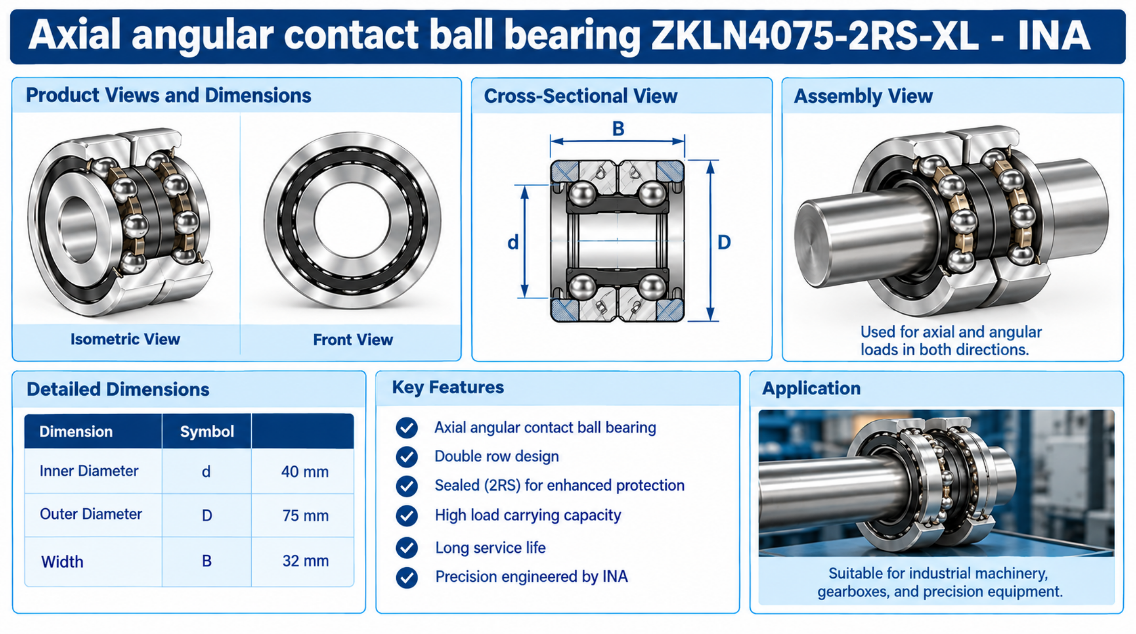
Product Specification:
| Product Name | ZKLN4075-2RS-XL - INA |
|---|---|
| Brand | INA |
| Product Code | TAI-0002 |
| Country of Manufacture | IN |
| Weight | 1.000 |
| Category | Angular Contact Ball Bearings |
| Bearing Number | ZKLN4075-2RS-XL |
What Is an Axial Angular Contact Ball Bearing?
An axial angular contact ball bearing is a thrust bearing where the balls touch the raceway at an angle, usually around 60 degrees, instead of straight across as in a standard thrust bearing. This angled contact spreads the load more evenly across each ball, which lets the bearing run at much higher speed while still carrying strong axial, or end-to-end, load.
Because of this angled design, the bearing can also take a small amount of side load along with the main thrust load, something a plain axial deep groove ball bearing cannot do well. This makes it a good fit for machine axes where speed, thrust, and a touch of radial support are all needed at the same time.
These bearings are often supplied as a single double-row unit, or as matched pairs meant to be fitted together in a back-to-back or face-to-face arrangement, so the whole system can handle thrust from both directions with high stiffness.
Axial Angular Contact Ball Bearing vs Axial Deep Groove Ball Bearing: What Is the Difference?
An axial deep groove ball bearing carries thrust load using balls that sit straight in a groove between two flat washers, which works well at lower and moderate speed but limits how fast the shaft can safely turn. An axial angular contact ball bearing uses an angled ball contact instead, spreading load more efficiently and allowing much higher speed along with some side load capacity. Where a job only needs slow-speed, one-direction thrust support, the deep groove type is simpler and cheaper; where speed and precision both matter, such as on a ball screw or spindle, the angular contact type is the stronger choice.
Types of Axial Angular Contact Ball Bearings
- Double Row Sealed Design (ZKLN Series): This compact, greased-for-life unit combines two rows of angled balls in one sealed housing, commonly used on ball screw ends in CNC machines.
- Double Row Open Design (ZKLF Series): Similar in layout to the sealed version but left open for external lubrication, chosen where a specific grease or oil system is already in place.
- Single Row, High Contact Angle Design: Built with a steeper contact angle for pure high-speed thrust duty, often used at the free end of a precision machine spindle.
- Matched Pair, Back-to-Back Arrangement: Two single row bearings are ground and supplied as a set so they can be mounted facing outward, giving strong support against thrust from either direction.
Axial Angular Contact Ball Bearing: Part Numbers, Sizes & Applications
The table below lists common series of axial angular contact ball bearings, their general size range, and where each is generally fitted. Share your shaft speed and thrust load figures with our technical team for an exact match.
| Part Number | Bore (mm) | Outer Dia. (mm) | Width (mm) | Bearing Type | Typical Application |
|---|---|---|---|---|---|
| ZKLN 2557 | 25 | 57 | 28 | Axial Angular Contact Ball Bearing (double row, sealed) | CNC machine ball screw support |
| ZKLF 1560 | 15 | 35 | 25 | Axial Angular Contact Ball Bearing (double row, open) | Precision linear actuator drive |
| BSB 040072 | 40 | 72 | 15 | Axial Angular Contact Ball Bearing (single row, 60° contact) | Machine tool spindle thrust end |
| QJ 210 | 50 | 90 | 20 | Axial Angular Contact Ball Bearing (four-point contact) | Rotary table and index drive shaft |
| ZKLN 3062 | 30 | 62 | 30 | Axial Angular Contact Ball Bearing (double row, sealed) | High-speed grinding machine feed screw |
| 7602 015 | 15 | 35 | 24 | Axial Angular Contact Ball Bearing (matched pair, back-to-back) | Packaging machine ball screw axis |
Benefits of Choosing the Right Axial Angular Contact Ball Bearing
- Runs at Much Higher Speed: The angled ball contact allows far faster running than a standard thrust bearing.
- Handles Combined Load: Carries strong thrust load along with a limited amount of side load at the same time.
- Keeps Ball Screws Accurate: High stiffness helps hold precise positioning on CNC and automated machine axes.
- Available Sealed or Open: Sealed types simplify maintenance, while open types suit custom lubrication setups.
- Supports Two-Direction Thrust: Matched pairs or double row designs resist load pushing from either side.
- Built for Long Duty Cycles: Precision grinding gives a smoother surface that resists wear during continuous high-speed use.
Country-Wise Use of Axial Angular Contact Ball Bearings in Our Export Network
Fast, precision machinery in each of our export markets calls for this bearing type in slightly different ways. Here is a short country-by-country look:
| Export Market | Where This Bearing Is Put to Work |
|---|---|
| Sri Lanka | Garment-industry CNC cutting tables use these bearings on ball screw axes that must stay accurate through long production runs. |
| South Africa | Automated tooling in metal fabrication shops uses this bearing on feed screws that move fast and must hold tight positioning. |
| UAE | High-end packaging lines in free-zone factories use these bearings on indexing and pick-and-place axes running at speed all shift long. |
| Nigeria | Plastic injection moulding machines use this bearing type on screw-drive axes where both speed and thrust load are present together. |
| Egypt | Printing press registration systems use these bearings to keep ball screw axes precise even at high cylinder speeds. |
| Indonesia | Textile winding and spinning machines use this bearing on fast-moving spindle ends that also carry constant end thrust. |
| Thailand | Automotive component machining lines use these bearings on CNC feed axes that demand both speed and positioning accuracy. |
| Kuwait | Process-plant valve actuator drives use this bearing where a compact, high-speed thrust component is needed in a tight housing. |
| Worldwide | Any machine axis that combines high rotational speed with a real thrust load, such as a ball screw or spindle end, is a good fit for this bearing. |
How to Select the Right Axial Angular Contact Ball Bearing
- Check the Running Speed: High shaft speed generally points toward this bearing over a plain axial deep groove type.
- Confirm Load Direction: Decide if load pushes one way only or if a two-direction matched pair is required.
- Estimate Any Side Load: A small amount of radial load is fine here, but heavy side load still needs a dedicated radial bearing.
- Decide on Sealed or Open Design: Pick sealed for easier upkeep, or open where a custom lubrication system already exists.
Common Mistakes to Avoid When Choosing an Axial Angular Contact Ball Bearing
- Using a Standard Thrust Bearing at High Speed: This causes early overheating and roller or ball damage in fast-running axes.
- Mounting a Matched Pair Incorrectly: Reversing the pair's back-to-back or face-to-face orientation reduces stiffness and shortens life.
- Ignoring the Preload Setting: Too little or too much preload on the pair affects both accuracy and bearing life.
- Overlooking Lubricant Suitability at Speed: The wrong grease grade at high speed leads to overheating even in a good-quality bearing.
Simple Maintenance Tips for Longer Life
Keep an ear out for a whining or grinding sound at running speed, since this often means the balls or raceway are starting to wear. Check ball screw positioning accuracy on a regular schedule, as a growing error is often an early sign of bearing wear rather than a screw problem. Follow the grease or oil interval recommended for the bearing's rated speed, since high-speed duty uses up lubricant film faster than slow-speed applications.
Request a fast export quote for axial angular contact ball bearings from Shree Balaji Export — trusted delivery to Sri Lanka, South Africa, UAE, Nigeria, Egypt, Indonesia, Thailand, Kuwait and worldwide.
Frequently Asked Questions
It is used to support high-speed thrust load, most often on ball screws, linear actuators, and machine spindle ends where speed and positioning accuracy both matter.
The angular contact type uses an angled ball contact that allows higher speed and some side load capacity, while the deep groove type uses a straight ball contact suited to slower, pure thrust duty.
Yes, to a limited extent. It can manage a small amount of radial load alongside its main thrust job, though heavy side load still needs a separate radial bearing.
A matched pair, mounted back-to-back or face-to-face, lets the system resist thrust load pushing from either direction while keeping high stiffness for accurate positioning.
Shree Balaji Export supplies axial angular contact ball bearings to Sri Lanka, South Africa, the UAE, Nigeria, Egypt, Indonesia, Thailand, Kuwait, and other markets worldwide, with complete export documentation and dependable delivery.
Common signs include a whining or grinding noise at speed, a drop in positioning accuracy on ball screw axes, and visible wear marks on the ball tracks during inspection.
 Shree Balaji Exports
Specialize in delivering top-quality bearings and related solutions to meet the diverse needs of various industries.