Ball Screw Bearing vs Standard Bearings: What Should Buyers Choose?
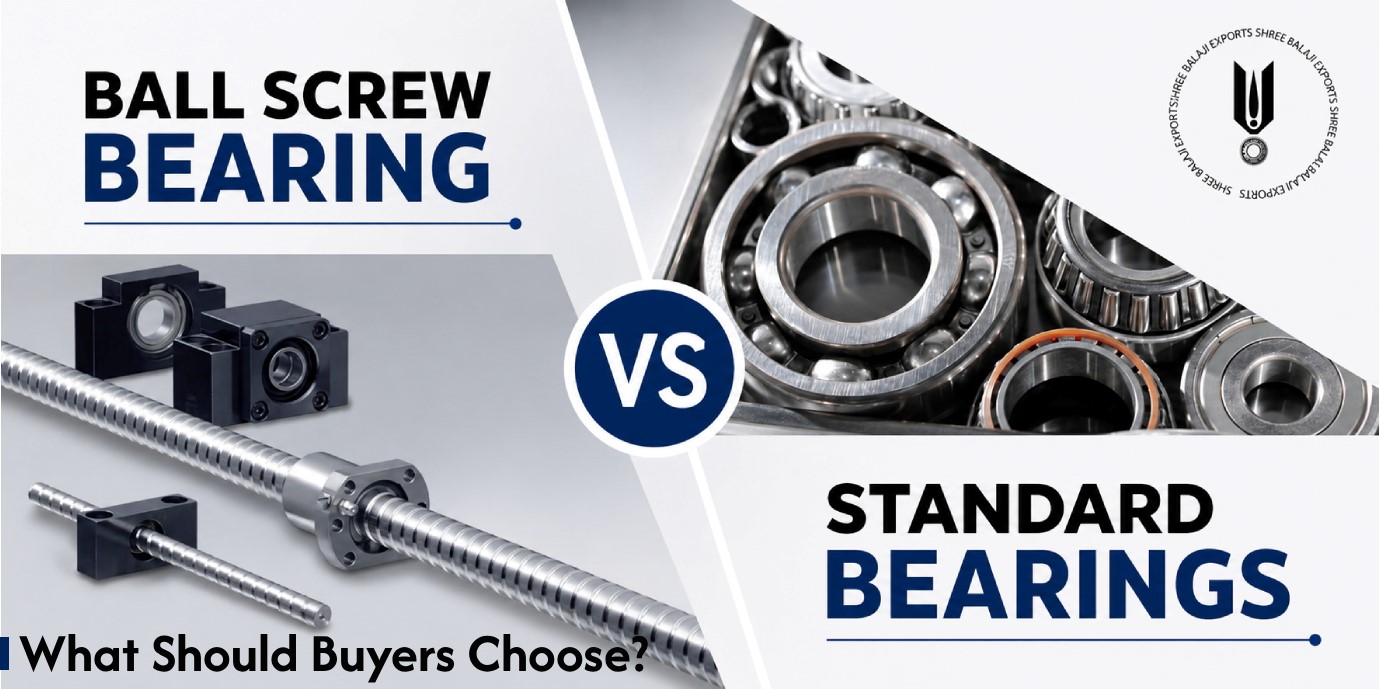
Selecting the right bearing is a critical decision that directly impacts the performance, accuracy, and lifespan of industrial machinery. For applications involving linear motion, high positioning accuracy, and axial load handling, buyers often face a common question: Should they choose ball screw bearings or standard bearings?
Understanding the differences between these two bearing types is essential for making the right investment. This guide explains how ball screw bearings compare with standard bearings, their applications, benefits, and which option suits specific industrial needs. With extensive experience in global bearing supply, Shree Balaji Exports helps buyers select export-quality bearing solutions that match performance requirements and international standards.
What Are Ball Screw Bearings?
Ball screw bearings are precision bearings specifically designed to support ball screw assemblies used in linear motion systems. These bearings primarily handle axial loads while maintaining extremely high positioning accuracy and rigidity.
Ball screw bearings are commonly manufactured as angular contact bearings and are often installed in matched sets to provide preload, ensuring zero backlash and superior motion control.
Key Characteristics of Ball Screw Bearings:
- Designed for high axial loads
- Extremely high precision and stiffness
- Low friction for smooth linear movement
- Capable of high-speed operation
- Preloaded to eliminate backlash
What Are Standard Bearings?
Standard bearings refer to commonly used bearing types such as deep groove ball bearings, cylindrical roller bearings, and tapered roller bearings. These bearings are designed to support radial loads, axial loads, or a combination of both, depending on the type.
Standard bearings are versatile and cost-effective, making them suitable for a wide range of industrial and automotive applications where ultra-high precision is not required.
Key Characteristics of Standard Bearings:
- Support radial and/or axial loads
- Wide availability and lower cost
- Suitable for general-purpose applications
- Easier installation and maintenance
- Available in various sizes and configurations
Key Differences Between Ball Screw Bearings and Standard Bearings
Load Handling Capability
Ball screw bearings are optimized for axial load capacity, especially in precision linear systems. Standard bearings can handle axial loads, but they are typically designed for radial load dominance.
Precision and Accuracy
Ball screw bearings provide superior positioning accuracy and rigidity. Standard bearings are sufficient for general machinery but may not meet the precision requirements of CNC and automation systems.
Speed and Motion Control
Ball screw bearings enable smooth, high-speed linear motion with minimal friction. Standard bearings perform well in rotary motion but may not offer the same level of control in precision linear applications.
Backlash and Preload
Ball screw bearings are often preloaded to eliminate backlash, critical for accuracy-sensitive machinery. Most standard bearings are not preloaded, allowing minimal play.
Cost Considerations
Ball screw bearings are more expensive due to their precision design and specialized manufacturing. Standard bearings are more cost-effective for general applications.
Applications Comparison
Ball Screw Bearing Applications
- CNC machines and machining centers
- Industrial automation and robotics
- Precision positioning systems
- Semiconductor manufacturing equipment
- Medical and optical machinery
Standard Bearing Applications
- Electric motors and generators
- Gearboxes and transmissions
- Pumps and compressors
- Conveyors and material handling systems
- Automotive and commercial vehicles
Which Bearing Should Buyers Choose?
Choose Ball Screw Bearings If:
- Your application requires high positioning accuracy
- Axial loads are dominant and constant
- Zero backlash is critical
- Equipment operates at high speeds with precision motion
- You are investing in CNC, robotics, or automation systems
Choose Standard Bearings If:
- The application is general-purpose
- Loads are primarily radial
- Precision requirements are moderate
- Budget optimization is important
- Easy availability and maintenance are priorities
Market Trends Influencing Buyer Decisions
Growth in Automation and CNC Machinery
The global shift toward automation, smart factories, and high-precision manufacturing has significantly increased demand for ball screw bearings.
Continued Demand for Standard Bearings
Despite advanced technologies, standard bearings remain essential due to their versatility, affordability, and widespread use in industrial and automotive sectors.
Focus on Reliability and Long Service Life
Buyers increasingly prioritize bearings that reduce downtime and maintenance costs, driving demand for high-quality, export-grade products.
Why Choose Export-Quality Bearings?
Regardless of bearing type, quality matters. Export-quality bearings offer:
- Precision manufacturing to international standards
- Longer service life and reliability
- Consistent performance under load
- Reduced maintenance and downtime
- Global compatibility and certification
This is why buyers rely on experienced suppliers with strong quality assurance systems.
Shree Balaji Exports: Helping Buyers Choose the Right Bearing
Shree Balaji Exports is a trusted global supplier of ball screw bearings and standard bearings for industrial and automotive applications. With in-depth technical knowledge and international market experience, the company helps buyers make informed decisions.
What Sets Shree Balaji Exports Apart:
- Comprehensive bearing range for precision and general applications
- Export-quality products meeting international standards
- Expertise in CNC, automation, heavy machinery, and automotive sectors
- Global export network across Asia, Africa, the Middle East, and Europe
- Dedicated technical support for correct bearing selection
By partnering with Shree Balaji Exports, buyers ensure optimal performance, reduced downtime, and long-term value.
Conclusion
Choosing between ball screw bearings and standard bearings depends entirely on application requirements. Ball screw bearings are the ideal choice for high-precision, axial-load-driven systems, while standard bearings remain the best option for general-purpose industrial and automotive applications.
Understanding load conditions, precision needs, and operating environments is essential for making the right choice. With expert guidance and export-quality solutions from Shree Balaji Exports, buyers can confidently select bearings that deliver performance, reliability, and efficiency in global industrial markets.
Need Help Selecting Between Ball Screw and Standard Bearings? Talk to Our Experts
Email: balajibearingco.16@gmail.com
Website: https://shreebalajiexport.in/
You can reach out directly to inquire or request a quote for Ball Screw Bearings.
 Shree Balaji Exports